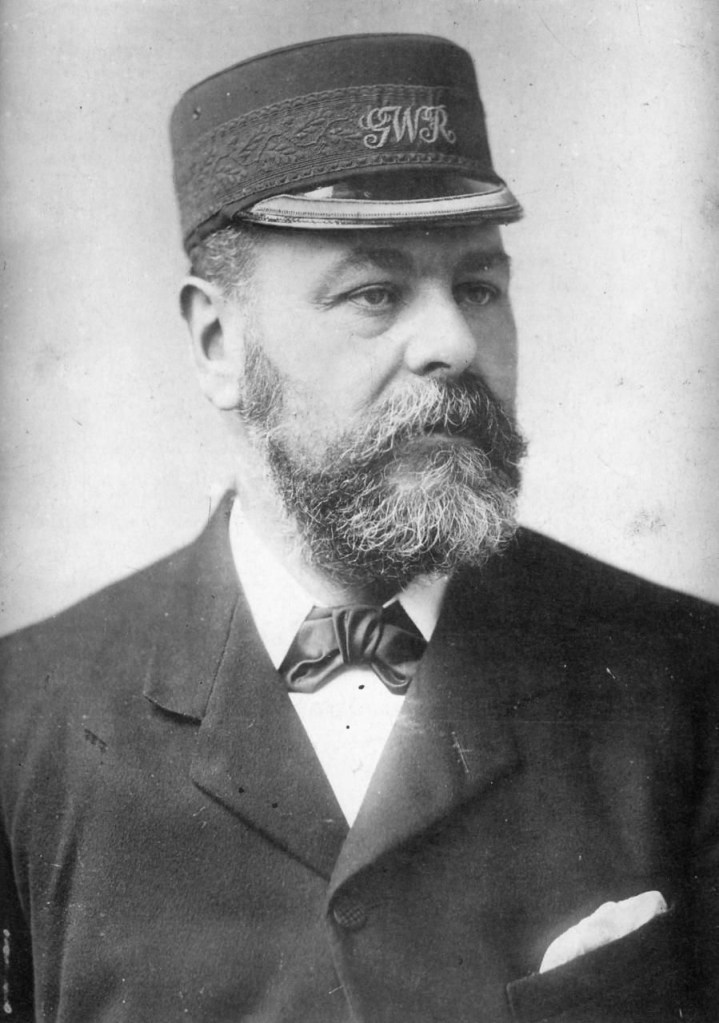
John Brewer (1846-1910) spent his whole working life as a railway man, starting with the Cornwall Railway as a boy in 1859 and retiring from the Great Western Railway in 1909.
Early life
John Brewer was born in Truro in late 1846, and he was baptised in January 1847. His parents were Richard Brewer, born around 1817 in St Columb Major, Cornwall, and Mary Ann Pascoe born in 1816 in Veryan, Cornwall; they married in Truro in 1844. Richard Brewer worked as a hotel waiter.
In 1846 John Brewer had one sister Elizabeth born in the previous year, but by the time of the 1861 census there were eight children all still living at home. John’s youngest brother Stephen also became a station master, but in the south east of England.
Career
After John Brewer’s retirement had been announced in 1909 he was interviewed for a newspaper article which includes some useful information about his career.
He commenced his railway career on May 18th, 1859 at Truro, passing through the various departments at a railway station of those days, namely, the parcels, booking and telegraph offices. He remained at Truro until March, 1871, and had made such good progress that in the month of the year last named, he was appointed Stationmaster at Penryn…
Swindon Advertiser and North Wilts Chronicle
Friday 18 June 1909
Since the first train on the Cornwall Railway ran from Plymouth to Truro on 12 April 1859, and the line opened for passengers on 4 May 1859, it is clear that John Brewer was there from the beginning. This means that when he started work with the Cornwall Railway he was only 12 years old. He appears in the 1861 census still living at home in Calenick Street, Truro, about half a mile from Truro Station, with occupation ‘telegraph clerk at railway’.
Brewer’s appointment as station master of Penryn in 1871 came about as a result of an accident at Liskeard which was attributed to the negligence of the Liskeard station master–Joseph H Coggins–who was dismissed. The Penryn station master–William H H Wright–was moved to Liskeard thus creating a vacancy. Penryn lies on the Truro-Falmouth branch of the line which had been opened in 1863.
Brewer’s 1871 census entry is intriguing. Census entries are usually fairly characterless, but here Brewer’s occupation has been entered as “clerk, Cornwall Railway” then crossed out and replaced with “Railway Station Master”. In the quotation above he states that he was promoted in March 1871. The 1871 census was taken on the night of April 2nd but enumeration forms were distributed a few days before for completion by household members. After collection the details from the forms were copied into the enumerator’s books. Perhaps Brewer initially completed the form before his promotion and then either corrected it himself or explained to the enumerator what had happened.
Within a few months he had been appointed to the position of station master at St Austell. This was certainly a promotion since St Austell was a bigger town than Penryn. He remained there for the next 15 years, until, in July 1886, the station master at Truro, Mr W H Watkins, stepped down due to ill health, and was succeeded by Brewer who had last worked in Truro in 1871. This was another promotion, since Truro was the original headquarters of the Cornwall Railway and was arguably the most important station on the line (the terminus at Devonport being the other contender).
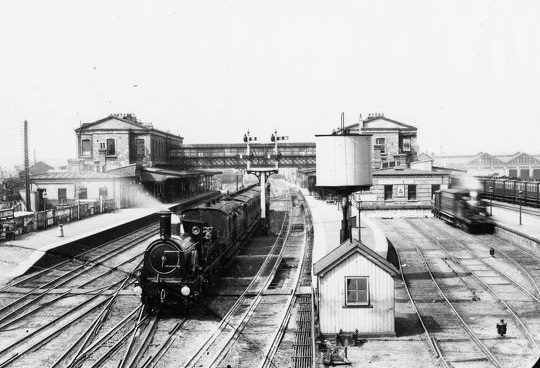
In 1897 Brewer was appointed station master at Swindon (the station was actually Swindon Junction). This was one of the stations on the original Great Western Railway from London, Paddington to Bristol and was always an important node in the network with connections to Oxford, to Bath and to Gloucester, South Wales and the West Midlands. It was also the site of Swindon Works, the GWR’s main maintenance and repair facility. John Brewer had reached the pinnacle of his career. He stayed at Swindon for the rest of his working life, retiring from the post of station master in July 1909.
Personal life
Brewer married Mary Minors Cock in Truro in October 1870 when he was 23 and she was 24. She was born in Truro, the daughter of Thomas Jenkin Cock, a grocer. Remarkably, her mother’s name was Mary Ann Pascoe, the same as that of John’s mother.
The Brewers had two sons, Lewis Arthur Brewer (born 1880) and Percival Pascoe Brewer (born 1889). Percival’s middle name commemorates the maiden names of both of his grandmothers. In the 1911 census Mary Minors Brewer, now a widow, reports that she has borne four children, of whom two had died, presumably in infancy.
It is clear from the interview in the Swindon Advertiser and North Wilts Chronicle that John Brewer led a very active social life, participating in, for example, wrestling, athletics, cricket, shooting, bird-fancying and bell-ringing. Upon moving to Swindon he seems to have entered into public life with gusto.
It would be superfluous to enlarge upon Mr. Brewer’s work and popularity during the twelve years he has been in Swindon, because all that is, locally, so well-known. He has served the town faithfully as a Councillor and an Alderman, he is a popular figure at nearby all public functions, and is the esteemed Chairman of the Swindon Football Club, and declares that next season Swindon intend to head the Southern League poll. It practically goes without saying that everyone who knows Mr. Brewer through the west of England and the Great Western system will cordially join in wishing him and Mrs. Brewer very many happy years in which to enjoy each other’s society.
Swindon Advertiser and North Wilts Chronicle
Friday 18 June 1909
In fact Swindon Town only came second in the Southern League in the 1909-1910 season but they did reach the FA Cup semi-final in 1910, losing to the eventual winners, Newcastle United. This resulted in Swindon Town being invited to play Barnsley (the losing finalists) in the Dubonnet Cup in Paris in May 1910, where they won. There is no evidence that John Brewer attended this match, although it would seem to have been a perfect adventure for him–perhaps he was already ill by then.
John Brewer died on the 19th September 1910, fifteen months after the publication of the quoted interview. In reflection of another of his activities, his funeral was attended by a large contingent of Freemasons. His estate was valued at £1705-1s-11d which is about £200,000 ($270,000) today. His wife Mary lived on in Swindon until 1927.

 Obscure Victorians